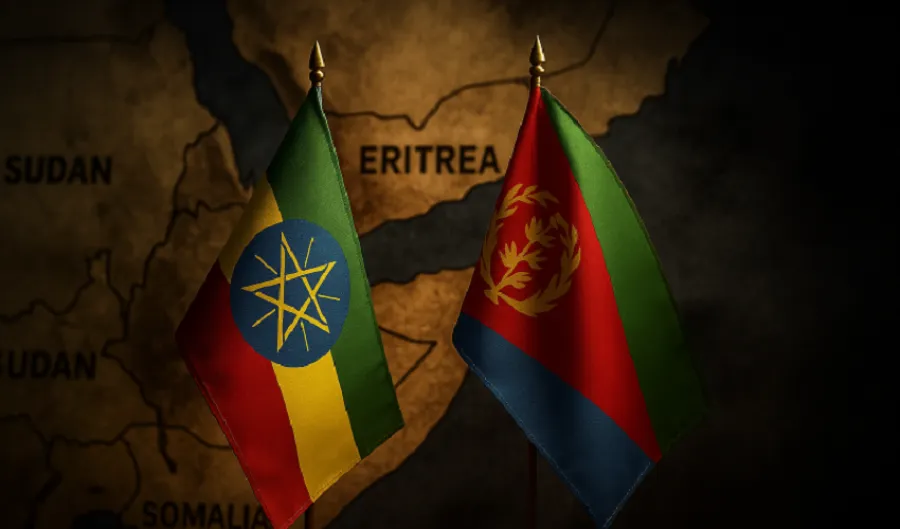
Twenty-five years after the Algiers Agreement, peace between Eritrea and Ethiopia faces the storms of the current phase.
The 25th anniversary of the Algiers Agreement, which ended the border conflict between Eritrea and Ethiopia, has arrived. Since its signing, this agreement has provided a crucial legal and diplomatic framework for achieving stability and peace between the two countries. This anniversary comes at a time of renewed tensions between Addis Ababa and Asmara, underscoring the importance of full adherence to the letter and spirit of the agreement amidst complex regional and international developments.
The conflict between Eritrea and Ethiopia has roots that go back more than a century, as Eritrea was under the administration of Italian settlers from 1889 for half a century, before its administration was transferred to the British army after Italy’s defeat in World War II.
Later, Eritrea was linked to Ethiopia in a federal system, but in 1962 Emperor Haile Selassie abolished the federation, and Eritrea became an integral part of Ethiopia, sparking a three-decade war. This war ended with Ethiopia's defeat in 1991, followed by a referendum in 1993 that formally recognized Eritrea's independence, bringing an end to a long period of armed conflict.
Relations between Addis Ababa and Asmara saw a relative improvement during the 1990s, but border disputes led to the outbreak of a new war in 1998. This war was devastating and resulted in the deaths of between 70,000 and 80,000 people on both sides, before Algeria intervened, as a neutral mediator, to sponsor the peace agreement signed in 2000.
The agreement established a clear legal framework for ending the war and preventing its recurrence, but it did not prevent subsequent tensions between the two countries. This continued until 2018, when Ethiopian Prime Minister Abiy Ahmed sought direct dialogue with Eritrean President Isaias Afwerki. This dialogue led to the signing of a declaration ending the war, for which Abiy was awarded the Nobel Peace Prize. However, the alliance between the two governments during the Ethiopian Civil War in the Tigray region between 2020 and 2022 reignited tensions, highlighting the fragility of the security situation in the region.
The essence of the Algiers Agreement and legal obligations
Dr. Abdel Nasser Salem Hamed, Director of the Sudan and East Africa Program at the Focus Research Center in Sweden, affirms that the essence of the Algiers Agreement lies in establishing a legally binding settlement to the border dispute through international arbitration. This settlement includes a commitment from both parties to respect the findings of the border demarcation commission, a cessation of hostilities, and a guarantee against the future use of force. In a statement to Al-Ayyam News, Dr. Salem Hamed indicates that these elements give the agreement a clear legal standing that can serve as a foundation for any subsequent efforts to achieve lasting stability.
The researcher, in a statement to Al-Ayyam News, believes that the agreement, despite its legal and political validity, remains contingent on the political actions of both parties, especially in light of the complex regional transformations. He describes Addis Ababa and Asmara's commitment as wavering, as political and security considerations have often overshadowed legal obligations, thus weakening the spirit of the agreement even though the legal texts remain in force and binding.
In commemoration of the 25th anniversary of the agreement, UN Secretary-General António Guterres reaffirmed the organization's support for the "historic" Algiers Agreement and urged both countries to recommit to the vision of lasting peace and respect for sovereignty and territorial integrity enshrined in the agreement, and to strengthen their good relations and neighborliness. Stéphane Dujarric, the Secretary-General's spokesperson, explained that seven years ago, the leaders of both countries renewed their commitment to peace through a joint declaration, reflecting the strength of the ongoing dialogue and cooperation between them.
Dr. Salim Hamed points out that the renewed UN support comes amid growing concerns about a potential escalation of the conflict and aims to send a strong diplomatic message that the international community will not accept a return to the use of force outside of agreed-upon legal frameworks. Guterres also called on both countries to continue working with regional and international partners to strengthen development cooperation in a way that serves the interests of their people and promotes stability in the region.
Challenges and the impact of the conflict on regional stability
Dr. Salim Hamed affirms that any tension between Ethiopia and Eritrea directly impacts the stability of the Horn of Africa, as it contributes to fueling proxy conflicts, facilitating the activity of armed groups, and threatening shipping lanes and security balances in a highly fragile region.
The researcher points out that adherence to the agreement not only means maintaining the borders of peace between the two countries, but its impact extends to the stability of the region as a whole, and enhancing the ability of neighboring countries to address common security challenges, including terrorism and the proliferation of irregular weapons.
Dr. Salem Hamed concludes by emphasizing that Algeria, as the sponsor of the peace agreement, has the ability to revitalize the diplomatic track in coordination with the United Nations, through quiet mediation initiatives based on the legal legitimacy of the agreement and its long historical experience in managing African conflicts, which has made Algerian mediation an international model to be emulated in resolving regional conflicts.
The passage of a quarter of a century since the Algiers Agreement highlights how difficult it is to maintain peace in a politically and geostrategically complex region, and confirms that lasting peace requires genuine political will, continuous international and regional support, as well as smart crisis management and the transformation of tensions into opportunities for dialogue and cooperation.