
Date: Monday, 29 December 2025
Eritrea asks Beijing to raise issue at the UN, saying it should ‘shoulder its moral responsibilities’ while drawing parallels with Taiwan
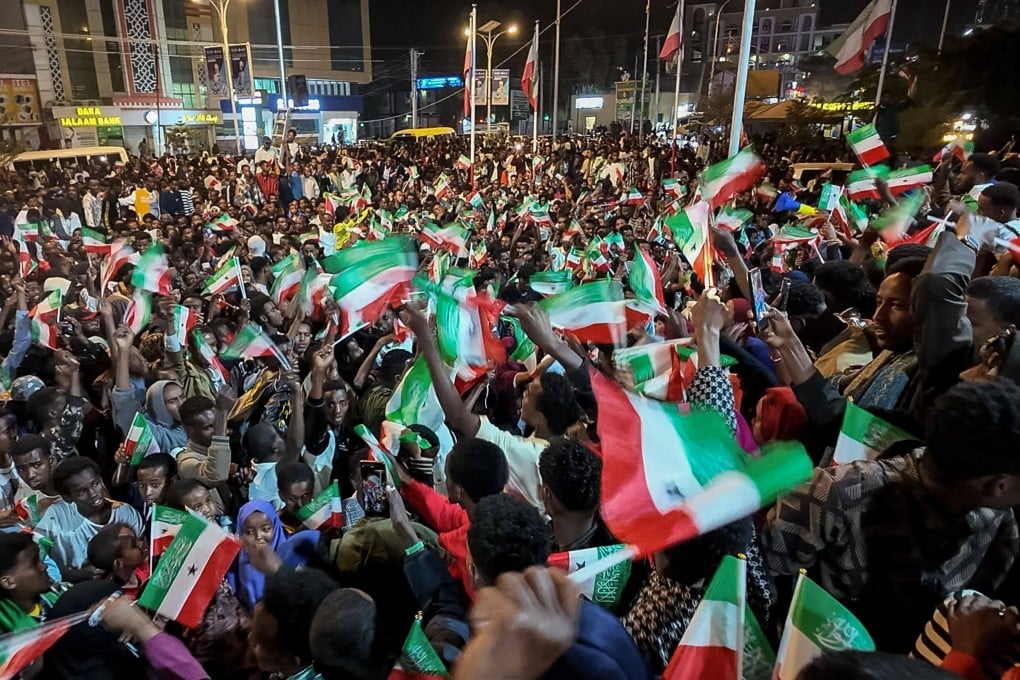
“China firmly supports Somalia’s sovereignty, unity and territorial integrity, and opposes any act of splitting Somali territory,” the ministry’s spokesman Lin Jian told a regular press briefing on Monday afternoon.
“We urge the Somaliland authorities to recognise the situation and immediately cease separatist activities and collusion with external forces,” Lin said, calling the Somaliland issue “entirely Somalia’s internal affair” that “should be resolved by the Somali people in a manner consistent with their national conditions and constitution”.
Eritrea, a fellow Horn of Africa nation, said China could use its power at the UN Security Council to stop the formal recognition of Somaliland.
On Sunday, the Eritrean ministry of information said the move was a “ploy” that had been “brewing for some time” to destabilise the region and was designed to incite “global crises and mayhem.”
Eritrea stressed it was “particularly incumbent on the People’s Republic of China to shoulder its moral responsibilities in view of the apparent analogy” with Taiwan.
Somaliland declared its independence in 1991, but Israel was the first country to grant it formal recognition.
The self-declared republic is close to the strategically important Bab al-Mandab strait linking Africa with Yemen, where the Houthi rebels have been battling government forces for years.
China’s interests are centred on securing the strait – which it regards as a “jugular vein” for the Maritime Silk Road – to protect global trade.
Its first overseas military base is in neighbouring Djibouti to help counter the possible emergence of a rival security hub in Somaliland.
Israeli Prime Minister Benjamin Netanyahu said the recognition of Somaliland was in “the spirit of the Abraham Accords”, the landmark 2020 agreements brokered by the United States to normalise relations between Israel and several Arab and Muslim-majority nations.
Netanyahu said Israel planned to immediately expand its relations with Somaliland in areas such as agriculture, health, technology and economics.
However, the move has also drawn sharp condemnation from Somalia and several neighbouring countries.
International and regional bodies – including the African Union, the Arab League, the Gulf Cooperation Council, the Organisation of Islamic Cooperation and the Intergovernmental Authority on Development, an east African bloc – have described the move as a threat to territorial integrity and a violation of international law.
China, which has vast interests across the Horn of Africa, has consistently resisted the formal recognition of Somaliland.
This stance has hardened into fierce opposition as the breakaway region strengthened its diplomatic and economic ties with Taiwan, particularly following the mutual establishment of representative offices in Hargeisa, the capital of the region, and Taipei in 2020.
David Shinn, a professor at George Washington University’s Elliott School of International Affairs, said China saw Somaliland as closely linked to Taiwan and “will do everything possible to discourage recognition of Hargeisa and will strongly support the territorial integrity of Somalia”.
When asked if the United States would follow Israel’s recognition of Somaliland, President Donald Trump replied in the negative but added that he would study the issue.
Despite the apparent ambiguity, the US Department of State said Washington continued to recognise the territorial integrity of Somalia.
Shinn said it appeared Washington would withhold recognition for the time being, partly out of concern it would complicate its support for the Somali government’s military campaign against Islamist groups such as al-Shabaab and the Islamic State.