________
By David Yeh
Business as Usual; Diplomatic and Funds Waste
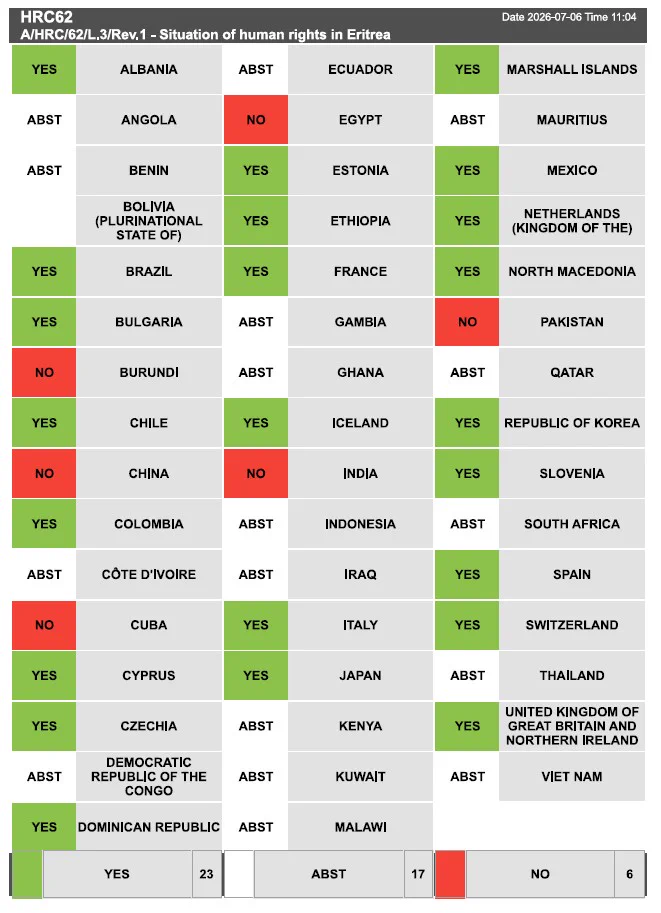
The United Nations Human Rights Council’s recent adoption of draft resolution A/HRC/62/L.3/Rev.1, which extends the mandate of the Special Rapporteur on Eritrea, stands as a stark reflection of the deep ideological fractures paralyzing modern global diplomacy. Introduced by the European Union during the Council's 62nd session, the resolution passed with twenty three votes in favor, six against, and seventeen abstentions. While Western delegates and international civil society groups celebrated the decision as a necessary victory for global oversight hypocritically arguing that monitoring is vital to ensure vulnerable populations are not left in total isolation the outcome has triggered fierce criticism from those who view the entire exercise as a redundant, politically compromised display of institutional inertia.
The voting patterns themselves exposed a profound continental rift, raising serious questions about the regional legitimacy of the mandate. Among the African nations seated on the Council, only Ethiopia voted alongside the Western bloc in favor of the resolution. This alignment has drawn intense scrutiny pointing out the blatant geopolitical contradictions at play, given that Ethiopia is currently entangled in its own severe internal conflicts and faces heavy international condemnation for using military drones against its own civilian populations. To many observers, this alignment is a continuation of long standing Western efforts to isolate Eritrea, highlighting how regional dynamics are frequently manipulated to serve external interests over collective continental solidarity.
Beyond the regional frictions, the renewal of the mandate has reignited a broader, more fundamental debate regarding the selective morality and financial efficiency of the United Nations. Opponents argue that the Council operates on a system of double standards, aggressively targeting specific nations while remaining relatively passive in the face of catastrophic humanitarian crises in regions like Gaza, Sudan, and the Democratic Republic of Congo.
Furthermore, because Eritrea routinely refuses to cooperate with or grant entry to the Special Rapporteur, the process inevitably devolves into a predictable diplomatic stalemate. Pouring millions of dollars into Geneva conferences, travel expenses, and lengthy reports that yield no practical change on the ground is a egregious misuse of global resources. From this perspective, these substantial funds would be far more effectively utilized if redirected away from diplomatic theater and poured directly into tangible development, food security, and healthcare infrastructure across the Global South.
Ultimately, the fallout from this resolution underscores two irreconcilable worldviews regarding the purpose of international oversight. On one hand, special interest proponents of the traditional system maintain that international scrutiny is the only tool available to challenge state opacity and keep global attention fixed on marginalized communities. A growing movement toward a new multilateralism asserts that country specific mandates infringe upon national sovereignty, waste precious humanitarian resources, and perpetuate outdated colonial dynamics. As the mandate extends into another year, the ongoing deadlock ensures that the tension between international intervention and state sovereignty will remain a central, unresolved flashpoint in global politics.