
Date: Sunday, 04 October 2026
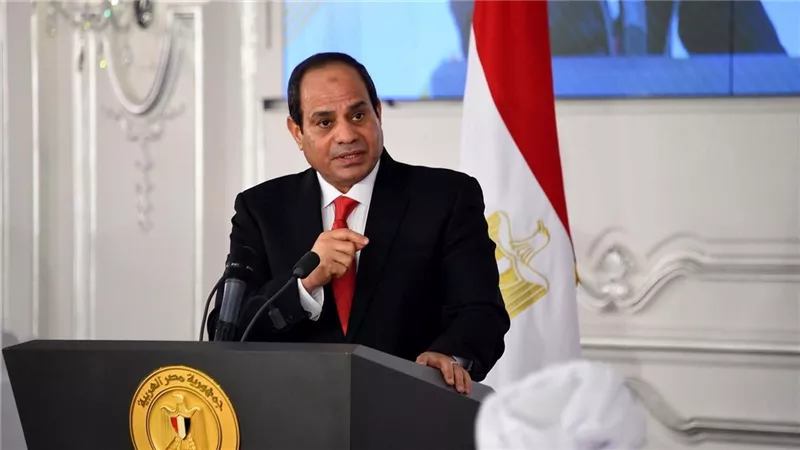 President Sisi
In exclusive statements to Newsroom, Marai explained that the African World Forum is not an isolated economic event, but rather comes amid tensions in the African continent, coinciding with the eighth mid-year coordination meeting of the African Union and the NEPAD summit. She pointed out that this integration raises the concept of linking peace and development, and how to achieve a close relationship between political and security stability and reconstruction and development efforts in countries affected by conflicts, such as Sudan and Somalia, in addition to the disturbances in the Horn of Africa region.
She added that the summits and events hosted by the new city of El Alamein provide what can be described as “quiet diplomacy,” with the participation of more than 20 heads of state and government representatives, explaining that the consultative summit that brings together President Abdel Fattah al-Sisi and the leaders of Eritrea, Sudan and Somalia comes in a prominent political and regional context.
The professor of political science confirmed that the summit will address a number of key themes, foremost among them joint regional coordination, through discussing regional issues of mutual interest, and confronting the disturbances and security challenges in the Horn of Africa, the Red Sea and maritime corridors.
She noted that the second axis relates to protecting sovereignty and stability, explaining that the consultations will focus on strengthening cooperation to protect the safety and stability of the participating countries, and emphasizing the need to respect the sovereignty of countries and their territorial integrity and not to interfere in their internal affairs, which is what President Abdel Fattah al-Sisi affirms.
She pointed out that the consultative summit coincides with the New Alamein City hosting the eighth mid-year coordination summit of the African Union, in which President Sisi is participating, and which discusses African work and continental integration issues.
Marai said that the timing of the summit is of particular importance, in light of the recent Ethiopian-Eritrean escalation, the unrest in Ethiopia, the renewed Tigray crisis, and the potential repercussions for regional security, the security of the Red Sea and the Horn of Africa.
She added that the summit comes directly after what she described as “tough diplomacy” decisions taken by Addis Ababa, including closing its embassy in Asmara and expelling Eritrean diplomats, and Eritrea’s response of cutting off relations completely, according to what she said.
She explained that the timing of the summit also comes amid diplomatic tension between Egypt and Ethiopia, with the two countries recently expelling diplomatic officials after Ethiopia declared one persona non grata, and Cairo responding in kind, in parallel with renewed fighting in the Tigray region.
The African affairs expert pointed out that the Renaissance Dam crisis represents one of the important issues in this context, in addition to the continued stalemate in negotiations, and Egypt’s adherence to its binding water rights with regard to the operation of the dam.
She added that this comes in parallel with Ethiopian attempts to secure a sea outlet on the Red Sea, moves that have sparked a crisis with Somalia, in addition to their repercussions on the relationship with Eritrea.
Marai stressed that the summit has strategic dimensions, as it could contribute to forming a cohesive regional bloc comprising four countries affected by current Ethiopian policies on a number of issues, including water, borders, and maritime and land sovereignty.
The African affairs expert predicted that the summit discussions would focus on four main issues, foremost among them the escalation with Ethiopia, especially in light of recent developments in diplomatic relations between Ethiopia, Eritrea and Egypt.
She explained that the second issue concerns the situation in Somalia, noting Egypt’s full support, along with the participating countries, for the unity and territorial integrity of Somalia, and its rejection of any agreements that would fragment the Somali state.
She added that the third issue would be the Sudanese crisis, stressing that Sudan’s security, sovereignty and stability represent a “red line” for Egypt, and that the latest field developments in Sudan are expected to be discussed.
She added that the fourth file relates to the security of the Red Sea, through coordination to protect navigation and to address security disturbances that threaten maritime routes, especially in the Bab al-Mandab region.
Marai said the summit will seek to develop a unified vision among the four countries, and formulate frameworks for developmental, economic and security cooperation, not just economic cooperation, with the aim of confronting regional challenges and imposing stability through peaceful means.
She pointed out the importance of not overlooking the agreements concluded by the four countries in recent years, explaining that Cairo had concluded a number of security and political agreements with the aim of protecting its interests and the foundations of its national security in the Red Sea region, in the face of Ethiopian moves that she described as part of an expansionist project aimed at changing the balance of power in the region.