Egyptian-Somali contacts are continuing regarding the security situation in the “Horn of Africa”, and the activation of the outcomes of the “Quadrilateral Summit”, which was hosted by the Egyptian city of El Alamein at the beginning of this month.
Egyptian Foreign Minister Badr Abdel-Aty discussed on Sunday with his Somali counterpart, Abdisalam Abdi Ali, "regional developments and issues of common interest," according to a statement from the Egyptian Foreign Ministry.
Egypt aims to "strengthen coordination with the countries of the Horn of Africa to support the stability of these countries," according to experts, who pointed out that "Cairo's position supports the unity and sovereignty of Somalia and rejects any infringement on its territorial integrity."
In a telephone call with his Somali counterpart, the Egyptian Foreign Minister discussed "ways to strengthen bilateral relations and continue developing cooperation in various fields."
According to a statement from the Egyptian Foreign Ministry, Abdel-Aati reiterated his country's firm position supporting the unity, sovereignty, and territorial integrity of Somalia, and supporting efforts to build Somali state institutions and enhance their capabilities.
The call also addressed “developments in the Horn of Africa and the Red Sea region,” and discussed “ways to follow up on the implementation of the outcomes of the (Quadrilateral) consultative summit hosted by the city of El Alamein, in order to support efforts to achieve security, stability, development and calm in the Horn of Africa and the Red Sea region.”
The city of El Alamein hosted a four-way consultative summit this October, bringing together Egyptian President Abdel Fattah al-Sisi, Eritrean President Isaias Afwerki, Somali President Hassan Sheikh Mohamud, and Sudanese Sovereign Council Chairman, Lieutenant General Abdel Fattah al-Burhan, to discuss “joint coordination in the Horn of Africa region,” according to the Egyptian Presidency.
Badr Abdel-Aty affirmed on Sunday “the continuation of close coordination with Somalia regarding various regional issues of common interest.”
Ambassador Salah Halima, a member of the Egyptian Council for Foreign Affairs, said that “coordination and consultation between Egypt and Somalia is not limited to the situation in the Horn of Africa.”
He added: “Coordination between Cairo and Mogadishu is ongoing, to support the capabilities of Somali institutions in facing various challenges.”
Halima explained to Asharq Al-Awsat that “continuous consultation between Egypt and the four countries of the Horn of Africa is required in light of the challenges facing that region.” He added that “among Egypt’s concerns is supporting the governance and security of navigation in the Red Sea by the countries bordering it, and rejecting the presence of non-shore countries on its coast.”
Egypt, Somalia, Eritrea and Sudan affirmed that “the principle of freedom of navigation and the governance of the Red Sea is the exclusive responsibility of the littoral states,” according to the “Al-Alamein Declaration” issued by the quadripartite summit.
“The challenges facing maritime routes in the region are pushing for intensified cooperation with the countries of the Horn of Africa,” according to former Egyptian Assistant Foreign Minister, Ambassador Hossam Issa, who said that “Egypt is keen to secure navigation in the southern Red Sea and the Bab al-Mandab Strait,” adding to Asharq Al-Awsat that “instability does not only affect the countries of the region, but extends to the countries of the world because of the impact of navigation in the Red Sea on global trade.”
Issa believes that “part of the Egyptian contacts with Somalia and the countries of the Horn of Africa aim to consult on protecting the safety of those regional countries, and to confront the movements of any separatist entities in the region.”
The joint statement issued by the El Alamein Quadrilateral Summit affirmed “support for the unity and sovereignty of Somalia, and the rejection of any interference or measures targeting its territorial integrity and national sovereignty,” and also affirmed the rejection of “any recognition or support for the so-called ‘Somaliland’ as this constitutes an infringement on the sovereignty and territorial integrity of the Federal Republic of Somalia.”

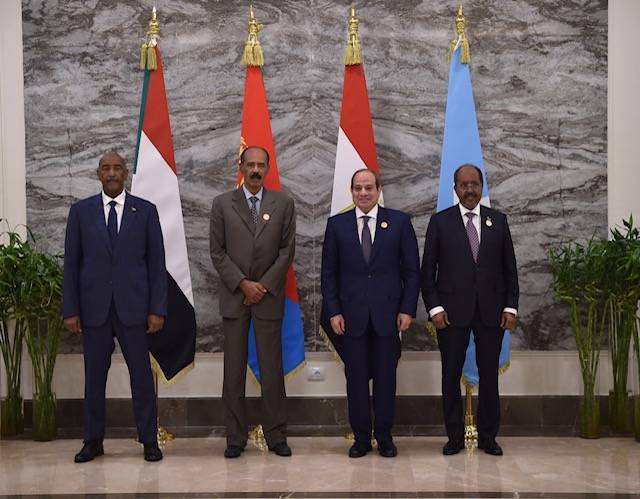 A "quadrilateral summit" for the leaders of Egypt, Somalia, Eritrea and Sudan in El Alamein (Egyptian Presidency)