
Date: Monday, 02 November 2026

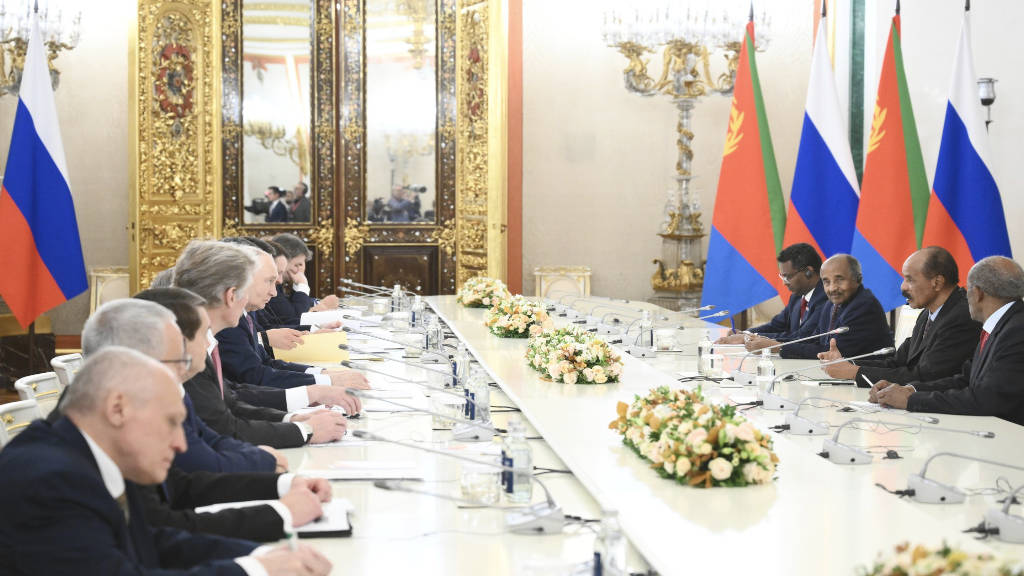
The Russian President, Vladimir Putin has met with Isaias Afwerki, the President of Eritrea at the Kremlin, on the sidelines of the 2026 Russia-Africa Summit.
From the Russian side, the meeting was attended by Deputy Prime Minister Andrei Nikitin, Deputy Prime Minister Alexander Novak, Deputy Chief of Staff of the Presidential Executive Office Maxim Oreshkin, Deputy Chief of Staff of the Presidential Executive Office – Presidential Press Secretary Dmitry Peskov, Presidential Aide Yury Ushakov, Ambassador Extraordinary and Plenipotentiary of the Russian Federation to the State of Eritrea Oleg Petrenko, Adviser to the President Igor Levitin, Deputy Foreign Minister Georgy Borisenko, Deputy Defence Minister Vasily Osmakov, Chief of the Main Directorate of the General Staff of the Russian Armed Forces – Deputy Chief of the General Staff of the Russian Armed Forces Igor Kostyukov, and Deputy Chief of the Main Directorate of the General Staff of the Russian Armed Forces, Andrei Averyanov.
This is what the two Presidents had to say:
Vladimir Putin: “Mr President, friends, good evening. We are delighted to see you. I would like to begin by thanking you for your participation in the Russia-Africa Summit. I believe that your involvement contributed to the positive results we have achieved. Today, we have an opportunity to discuss our bilateral relations.
Russian-Eritrean relations are progressing. Obviously, we should devote greater attention to trade and economic cooperation and explore ways to increase our trade. We see potential in such sectors as energy, mining, infrastructure, agriculture, and fisheries. We are also providing assistance to enhance your food security.
Russia and Eritrea share common positions on many pressing issues on the international agenda. And, of course, we are grateful to you, Mr President, for supporting Russian initiatives at the United Nations and at other multilateral forums. We appreciate this support, and I would like to assure you of that. Once again, I would like to express my gratitude for our joint efforts.
We have already worked productively during the summit events. And, once again, we welcome this opportunity to discuss our bilateral ties and ways to develop them further.”
Isaias Afwerki: “It is a great, great honour for me to see you again after probably more than one year, and I see you are still strong, participating in these meetings. It’s quite interesting to someone like me to observe this strength in you, so that Russia could be stronger to make its contribution to any partnership with Africa.
One interesting thing that I observed yesterday was after the opening session, the presentation on a number of disciplines, a number of traits was quite exciting. And your intervention on clarifying all those points was inspiring to me, to be frank with you. It was inspiring and encouraging. I can see President Putin is actively engaged in all these issues.
One thing that struck my mind was, given the obvious environment and climate for Russia–Africa summit. My perception about the situation in Africa is very dire. The capability of African economies and African governments to make their contributions is indeed limited. We need to recognise that fact in the first place. Comparing that with the potential of Russia, with the resources here, the technology, the industry base in Russia, Russia should take the lead and make its contributions. This is not an intervention in the African affairs but a contribution from Russia. It is expected to be as high as anyone can imagine. The way I see things happening here in Russia, my suggestion was to come up with a set of rules that will have to be put on the ground for every nation on the African continent, to start implementing programmes in a number of sectors. They need to have a reference for that to do.”
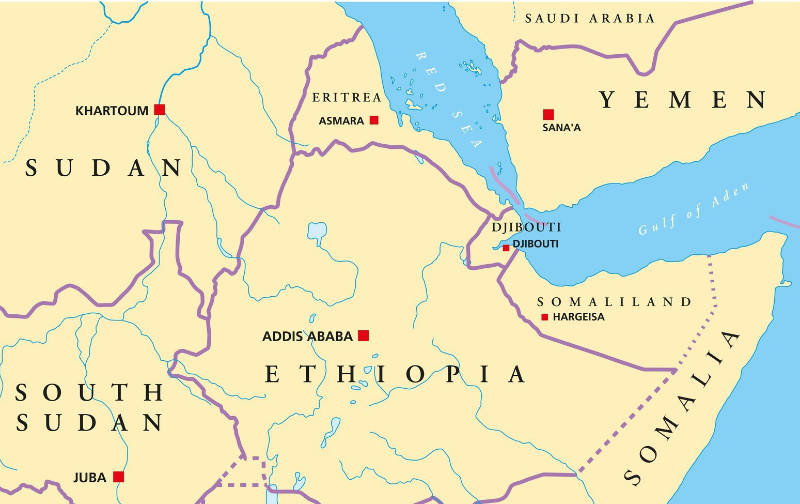
Eritrea is located in the Horn of Africa region of East Africa, bordered by Ethiopia to the south, Sudan to the west, and Djibouti to the southeast. The northeastern and eastern parts of Eritrea have an extensive coastline along the Red Sea. It is currently undergoing a de facto conflict over disputed borders with Ethiopia, while relations with Yemen, on the opposite side of the Red Sea are also tense concerning disputed islands. These conflicts have seriously damaged Eritrea’s stability and prosperity. However, relations with Russia, while trade minimal, are politically positive – Eritrea was one of only four countries to vote against a United Nations General Assembly resolution condemning Russia’s 2022 conflict with Ukraine.
Mining and agriculture in 2021 account for 20% of Eritrea’s GDP, while remittances from abroad are estimated to account for 12% of gross domestic product. Chinese investors are primarily involved in the mining sector, while agriculture also accounts for about 20% of GDP. Eritrea has 565,000 hectares (1,396,000 acres) of arable land and permanent crops. 70% of the Eritrean workforce is employed in agriculture, accounting for roughly one-third of the economy. Eritrea’s main agricultural products include sorghum, millet, barley, wheat, legumes, vegetables, fruits, sesame, linseed, and livestock farming in cattle, sheep, goats, and camels.
Eritrea is a member of the Common Market for Eastern and Southern Africa (COMESA) but is the only African nation not to have signed up to the pan-African Continental Free Trade Agreement.
Eritrea has a population estimated at about 5 million, and a GDP (PPP) of about US$6.5 billion. GDP per capita (PPP) is US$1,820, while the 2024 GDP growth rate was 2.9%, mainly driven by the mining and services sectors.
Russia is poised to make investments in Eritrean ports as Moscow has entered into talks to set up a logistics centre in the country. It is believed to be an additional port for Eritrea’s potash exports. Eritrea has attended the biannual Russia-Africa summits and is politically aligned with Moscow, with the Russian Navy on occasion using Eritrean ports as Red Sea stop overs. The two sides are known to have discussed the Eritrean economy, raw material mining, information and communications technologies, agriculture, infrastructure projects, and the capabilities of the Mitsiwa naval port and airport.
However, balanced against this is Russia’s relationship with Ethiopia, a full member of BRICS.
The latest developments highlight Moscow’s attempt to maintain its longstanding relationship with Eritrea while expanding its strategic partnership with Ethiopia. Although Putin expressed readiness to strengthen cooperation with Asmara, the Russian government’s simultaneous engagement with Addis Ababa illustrates the competing interests shaping its foreign policy in the Horn of Africa. Moscow has offered to mediate between the two parties and would ideally like to see Eritrea and Ethiopia settle their differences and work together rather than be engaged in conflict. Until Eritrea’s overall political and trade isolation and its relations with Ethiopia can be resolved, investment made into its Red Sea coastline potential, and prospects for bilateral trade development remain positive, yet rather small and subject to regional tensions.
2025 Russia-Eritrea bilateral trade reached US$13.5 million in 2025, with most of this being Russian exports of grains and fertilizers.