
Date: Monday, 16 October 2017
The number of people in Africa suffering from hunger had been receding for some years. But it is now on the rise again. 26 million Africans face starvation. A special series by DW Africa explains why.

It is one of those situation when you really only understand what happened after it is over. A doctor and a nurse try to revive a little child. Sitting on her bed, the parents don't move. After a couple of minutes, the doctor orders all revival efforts to be stopped. A quiet sobbing fills the silence; then a cry. An orderly pulls up a screen to give the parents some privacy. We don't see what happens next.
This incident which took place in a clinic in northern Kenya was the most difficult emotional moment of our research trip through African regions hit by hunger. It made very clear that the 26 million people threatened with starvation are not a statistic and that for many of these people hunger is more than just a threat. The little girl in the Kenyan hospital did not die in an accident or from an incurable disease. She died because she had not eaten for too long.

Hunger doesn't make the headlines
DW reporters crossed many African countries for several weeks to track the hunger crisis. They talked to development helpers, experts, politicians and above all to the people affected to find out more about the reasons for so much suffering.
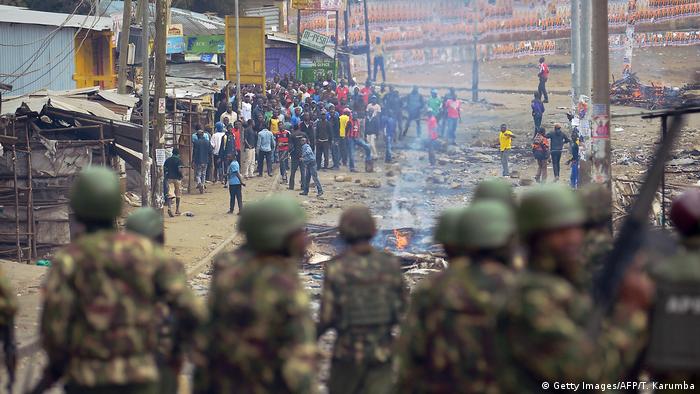
The main causes of hunger in Africa are violence and conflicts
Some time ago, aid organizations started raising the alarm on hunger in Africa, which is why this series of reports is so timely. They have been warning that an expanding drought could result in one of the most terrible hunger catastrophes of the last decades in Africa and the Yemen. But soon the predicted crises stopped making the headlines – although the situation hasn't really improved. In South Sudan and Somalia, two of the hardest hit countries, 14 million people remain dependent on food aid.
People as the main cause
What led to these dramatic situations? The reports' answer to that is unequivocal: people did, not nature. Worldwide climate change, massive deforestation and one-sided cultivation are making life increasingly difficult for African small-scale farmers.

But political conflicts have even more devastating consequences. Countries most affected by hunger such as Nigeria,South Sudanand Somalia, are either embroiled in a civil war or they are fighting terrorists. In these countries, the state has failed to provide basic needs like providing health services, education or security. In lieu of which small elites are busy filling their own pockets in countries which often have considerable resources.

Climate change and neglectful agricultural policies have made life difficult for African smallholders
Cautious optimism
Nevertheless, DW's reporters also came back with stories of hope. For instance, after more than 20 years of civil war, at the start of 2017 Somalia got a new government. This had many observers voicing cautious optimism. And everywhere the reporters met people who grow beyond themselves in exceptional circumstances and do not just give up. Because people are not only the cause of hunger, they are also its solution.
From October 16, you can also follow DW's series on hunger in Africa daily on radio and TV underwww.dw.com.
*******************************************************************************
Hunger levels are surging globally, with crises escalating in Yemen and South Sudan. As we mark World Food Day, DW learns how failing to tackle suffering today will leave a dangerous legacy for tomorrow.

Today marks World Food Day - an annual reminder of the suffering still endured by so many millions around the world. It is also a chance to celebrate the measurable steps taken towards achieving a UN-led goal to eliminate hunger and malnutrition by 2030.
This year though, that celebration is distinctly muted. Hopes built up over years of progress in the fight against hunger have been dealt a cruel blow.
Read more: Millions on the brink of severe food crisis
A damning report released last month revealed that global hunger levels have increased for the first time in over a decade. It found that some 815 million people were suffering from hunger in 2016 — 38 million more than in the previous year.
The World Food Program (WFP) has called these figures an "indictment on humanity," while the United Nations has warned that surging hunger levels are the greatest humanitarian disaster since World War Two. The misery endured today by those in need is beyond comprehension. And yet, hunger and famine can also leave behind a dangerous legacy. A legacy that can be felt years after the worst of the crisis has subsided.
Hunger fanning flames of extremism
In an interview with DW, the World Food Program's chief economist has highlighted the potential that hunger has to fan the flames of extremism and conflict in crisis-hit areas. Arif Husain warned it can be a key ingredient in a combination of factors that can lead those most vulnerable towards radicalization.

Arif Husain, the World Food Programme’s chief economist
"Together, poverty, hunger and illiteracy are a cocktail which gets exploited by external factors in terms of extremism," Husain said.
His warning has been echoed by Virginia Comolli. a Senior Fellow for Security and Development at The International Institute for Strategic Studies (IISS). "Poverty, including food shortages, have been known as factors exploited by jihadi groups to attract more recruits," she told DW.
Comolli, whose recent book explores the rise of Nigeria-based Islamist group Boko Haram, said her research had recorded this phenomenon in the recruitment of some of the group's most vulnerable members.
"In its early days, Boko Haram's rhetoric appealed to local northern Nigerians, as well as nationals from other Lake Chad Basin countries who would happily leave their towns affected by desertification, a shrinking Lake Chad and resulting fishing shortages, to listen to Boko Haram's sermons and benefit from micro loans offered by its leader," she said. "Later on, group membership became an answer to unemployment for many of its followers."

A mother waits for medical treatment for her starving child in Somalia.
UN hunger target in jeopardy
To mark World Food Day, the WFP is calling for urgent action to reverse the recent surge in hunger levels and to protect those most vulnerable to exploitation if there is to be any hope of stifling further suffering in years to come.
"If we want to curb the menace of extremism — whether it is in northeast Nigeria or South Sudan or Yemen or Syria or elsewhere — you have to invest in those kids before they lose hope," Husain told DW. "We live in a globalized world. It is no longer somebody else's problem. It is our collective problem."
The first step, the WFP says, is tackling a handful of the man-made root causes of hunger. Chief among them: conflict.
"Sixty percent of people who are hungry every day are living in countries suffering from conflict," Husain told DW.
Unless we resolve these conflicts, there is "no way" we can achieve our Sustainable Development Goal to eliminate hunger and malnutrition by 2030, he added. "This is a very solvable problem. We provide enough food and the economics of solving hunger makes sense, but we haven't done it. Why is that? Conflict?"
"I just can't believe that in the 21st century we are still talking about hunger."
Yemen on brink of mass starvation
Famine hit parts of South Sudan earlier this year, and near famine conditions continue to exist in an additional three countries affected by conflict — northeast Nigeria, Somalia and Yemen.
According to UN data, over a quarter of the population in Yemen is on the brink of famine. The country has been devastated by over two years of civil war.
Concern is also growing for refugees fleeing devastation in Myanmar. Aid organizations have issued urgent appeals to support some 700,000 people who have fled to Bangladesh and are in dire need of food.
To counter the surge in global hunger, the WFP is launching new funding initiatives, including a renewed push for Persian Gulf states to contribute more to fight famine in Yemen.
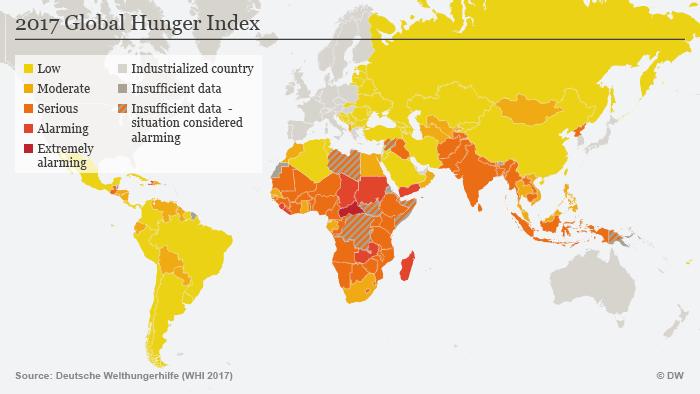
Hunger an 'indictment on humanity'
So far this year, Saudi Arabia — which is leading a coalition carrying out airstrikes in Yemen — has shelled out an estimated $12 million to the WFP's emergency operation there. That compares to about $260 million from the United States, a WFP spokeswoman told news agency Reuters.
WFP chief David Beasley spoke at the UN General Assembly last month, delivering a pointed message to nations in the Gulf: "What we're challenging are the Persian Gulf states to step up and do more, particularly when these conflicts are predominantly in your region."
While sustained humanitarian assistance is absolutely necessary to avert famine and saves lives, it is not sufficient to put an end to global hunger, Husain says. At least, not while ongoing and emerging conflicts show little sign of subsiding.
World Food Day falls annually on October 16. As in previous years, the day will be marked by a series of events in some 150 countries around the world. They include marathons, exhibitions, cultural performances, contests and concerts.